
FHA Loan Requirements in Massachusetts 2026 — A Complete Guide for Buyers
What are the FHA loan requirements in Massachusetts in 2026?
To qualify for an FHA loan in Massachusetts in 2026 you need a minimum credit score of 580 for a 3.5% down payment, or 500 to 579 with a 10% down payment. Your debt-to-income ratio should generally be at or below 57%, though most lenders prefer 50% or lower. The home must be your primary residence. FHA loan limits in Massachusetts vary by county — Essex and Middlesex counties, which include Beverly, Salem, Peabody, Danvers, Swampscott, and Waltham, have a 2026 FHA loan limit of $962,550 for a single-family home. Down payment assistance programs including MassHousing DPA and MassDREAMS can be layered with FHA financing to reduce or eliminate the out-of-pocket down payment requirement.
The popularity of FHA Loans
FHA loans are one of the most widely used mortgage programs in Massachusetts — and for good reason. In a state where the median home price reached $715,000 in late 2025, the combination of a 3.5% minimum down payment, flexible credit score requirements, and a debt-to-income allowance that surpasses conventional guidelines makes FHA the most accessible path to homeownership for a large share of Massachusetts buyers.
Despite their popularity, FHA loans are also one of the most misunderstood. Many buyers assume FHA is only for first-time buyers — it is not. Many assume FHA cannot be used in Massachusetts's high-price markets — it can. And many assume FHA mortgage insurance is permanent — it is only permanent in specific situations, and the exit strategy is straightforward once equity is built.
This guide covers everything a Massachusetts buyer needs to know about FHA loans in 2026: loan limits by county, credit and income requirements, mortgage insurance costs, how to layer FHA with down payment assistance, and when FHA makes sense versus conventional financing.
Sean Goudreau is a Top 1% Massachusetts mortgage lender and MassHousing-approved lender. Free consultation at (781) 202-9056.
2026 FHA Loan Limits in Massachusetts by County
FHA loan limits are set annually by HUD and vary by county based on local home prices. Massachusetts is predominantly a high-cost state, meaning most counties carry FHA limits significantly above the national baseline of $541,287.
Here are the 2026 FHA loan limits for single-family homes in Massachusetts counties most relevant to Sean's service area:
Essex: $962,550, including Beverly, Salem, Peabody, Danvers, Swampscott, Lynn, Gloucester, Newburyport
Middlesex: $962,550, including Waltham, Lexington, Bedford, Burlington, Woburn, Cambridge, Concord
Norfolk: $962,550, including Quincy, Brookline, Dedham, Needham, Wellesley
Suffolk: $962,550, including Boston, South Boston, East Boston, Charlestown, Revere
Plymouth: $962,550, including Brockton, Plymouth, Hingham, Duxbury
Dukes: $1,249,125, including Martha's Vineyard
Nantucket: $1,249,125, including Nantucket
Hampden: $541,287, including Springfield, Chicopee, Holyoke
Hampshire: $541,287, including Northampton, Amherst
Franklin: $541,287, including Greenfield, Montague
Berkshire: $541,287, including Pittsfield, North Adams
The $962,550 limit in Essex and Middlesex counties is one of the highest FHA limits in New England. This means FHA financing is genuinely viable across the full price range of Sean's North Shore and Greater Boston service area — including at price points that many buyers assume require conventional or jumbo financing.
Multi-family FHA limits: FHA loan limits increase for two, three, and four-unit properties. In Essex and Middlesex counties, the 2026 FHA limits for multi-family properties are approximately $1,232,250 (2-unit), $1,489,500 (3-unit), and $1,851,100 (4-unit). This makes FHA a powerful tool for buyers who want to purchase a multi-family property with a small down payment while occupying one unit.
FHA Credit Score Requirements in Massachusetts
FHA's credit requirements are more flexible than conventional loans, which is one of the program's primary advantages for buyers whose credit history is imperfect or still being established.
580 or above: Eligible for the standard 3.5% minimum down payment. This is the threshold most Massachusetts FHA buyers fall into.
500 to 579: May still qualify for an FHA loan but requires a minimum 10% down payment. Fewer lenders offer this tier, but options exist for buyers who are close to the 580 mark and want to purchase sooner rather than waiting to improve their score.
Below 500: Not eligible for FHA financing. A credit improvement strategy is required before applying.
Practical note for Massachusetts buyers: The 580 minimum is FHA's floor — individual lenders often apply their own overlays that require a higher score. Most Massachusetts lenders prefer 620 or above for FHA, and 640 for the best program access including MassHousing DPA layering. If your score is between 580 and 620, Sean can advise on whether you are ready to apply now or whether a short credit improvement effort makes sense given your timeline.
What impacts your credit score for FHA purposes: Payment history is the most important factor — late payments in the past 12 months are a significant flag. Credit utilization, age of accounts, and recent inquiries also matter. Bankruptcy and foreclosure have specific waiting periods — generally two years post-discharge for bankruptcy and three years post-foreclosure before FHA eligibility is restored.
FHA Down Payment Requirements in Massachusetts
The 3.5% minimum down payment is FHA's signature feature and the primary reason the program is so widely used in Massachusetts's high-price market.
What 3.5% looks like at Massachusetts price points:
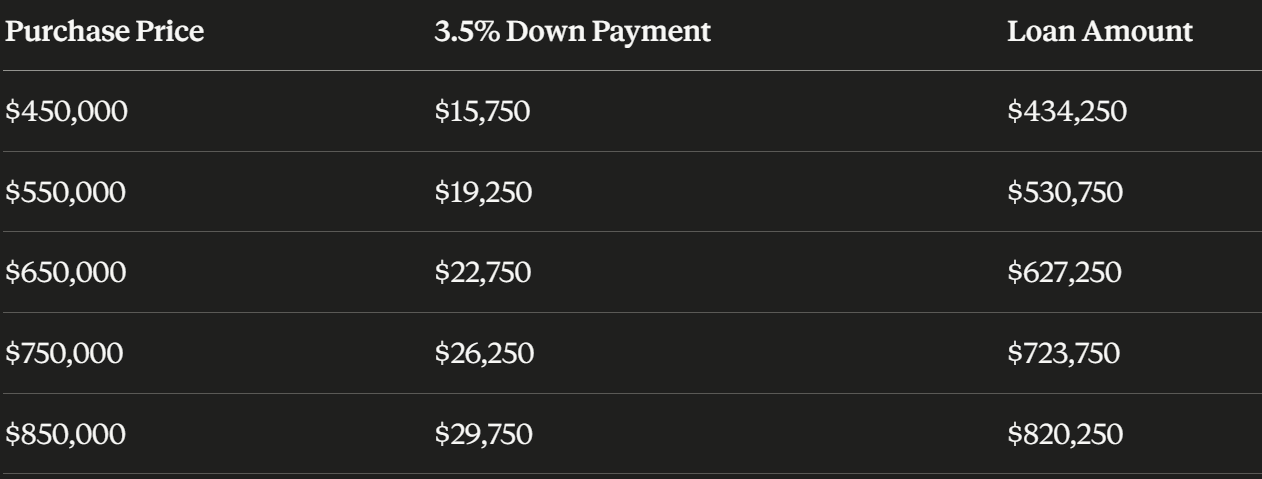
Even at $750,000 — a realistic target price in many North Shore and Greater Boston communities — the minimum FHA down payment is $26,250. This is a fraction of the $150,000 required for a 20% conventional down payment at the same price point.
Down payment gift funds: FHA allows the entire down payment to come from a gift from a family member, employer, or approved nonprofit. The gift must be properly documented — a gift letter confirming the funds are not a loan — but FHA is more permissive about gift fund sourcing than most conventional programs.
Down payment assistance compatibility: FHA is fully compatible with Massachusetts's major DPA programs:
MassHousing DPA: Up to $30,000 (through July 31, 2026 under the current promotion) can cover the 3.5% down payment on most North Shore purchase prices
MassDREAMS: Up to $50,000 for eligible community residents (Salem, Peabody, Lynn) — can cover the full down payment and a portion of closing costs
FHLB Boston grants: Up to $4,000 as a supplemental layer
For an income-qualified Salem buyer purchasing at $550,000 with FHA, MassDREAMS can cover the entire $19,250 down payment and a meaningful portion of closing costs — making the out-of-pocket cash requirement at closing minimal.
FHA Debt-to-Income Requirements in Massachusetts
FHA's debt-to-income flexibility is one of its most underappreciated advantages in Massachusetts's high-price market. Many buyers who are declined by conventional lenders find that FHA's more generous DTI allowance opens the door.
DTI defined: DTI is the percentage of gross monthly income consumed by monthly debt obligations including the new mortgage payment, property taxes, insurance, and all existing debt payments (car loans, student loans, credit cards, etc.).
FHA DTI guidelines:
Front-end DTI (housing expenses only): Generally 31% or below preferred
Back-end DTI (all debts including housing): Generally 43% or below is the standard, but FHA allows DTI up to 57% with strong compensating factors
What compensating factors allow higher DTI: Significant cash reserves, a large down payment above the minimum, a demonstrated history of saving and managing credit responsibly, or residual income above FHA thresholds can support approval at DTI ratios above 43% through 57%.
Massachusetts context: In Essex and Middlesex counties, where median prices are $650,000 to $750,000 and above, housing costs relative to income are inherently higher than national norms. FHA's willingness to approve at higher DTI ratios — with proper compensating factors — makes it viable for Massachusetts buyers who would be turned down by conventional programs at the same purchase price.
Conventional comparison: Most conventional loans cap DTI at 45% to 50%. FHA's allowance up to 57% is a meaningful difference for buyers stretching to purchase in competitive Massachusetts markets.
FHA Mortgage Insurance — What It Costs and How to Exit
FHA mortgage insurance is the most commonly misunderstood cost in the program. Understanding exactly how it works, what it costs, and when and how to exit it is essential before committing to an FHA loan.
Two types of FHA mortgage insurance:
Upfront MIP (UFMIP): A one-time fee of 1.75% of the base loan amount, charged at closing. It is almost always rolled into the loan rather than paid out of pocket. On a $627,250 loan (3.5% down on a $650,000 purchase), UFMIP is $10,977 added to the loan balance.
Annual MIP: An ongoing premium charged monthly, calculated annually as a percentage of the outstanding loan balance. For most Massachusetts buyers in 2026 using a 30-year FHA loan with less than 10% down, the annual MIP rate is 0.55% of the loan amount. On a $627,250 loan, this is approximately $288 per month.
MIP duration — this is where many buyers are confused:
For FHA loans originated on or after June 3, 2013:
Down payment less than 10%: Annual MIP remains for the life of the loan
Down payment of 10% or more: Annual MIP is removed after 11 years
This means most FHA buyers in Massachusetts — who use the 3.5% minimum down payment — will pay mortgage insurance for the life of the loan unless they refinance.
The exit strategy: Refinancing from FHA into a conventional loan once you have built 20% equity eliminates MIP entirely. In Massachusetts, where home values have appreciated meaningfully over the past decade, many FHA buyers reach 20% equity significantly faster than their loan amortization schedule suggests — through a combination of principal paydown and price appreciation. At that point, refinancing into conventional removes MIP and typically reduces the monthly payment.
Sean maps out this refinance timeline for every FHA buyer at the point of purchase — so you understand from day one when the crossover makes sense.
FHA vs. Conventional — When FHA Wins in Massachusetts
FHA is not the right choice for every Massachusetts buyer. Here is a clear breakdown of when it makes sense versus conventional.
FHA wins when:
Credit score is below 680 — FHA's pricing tiers are more favorable at lower credit scores than conventional
Down payment is under 10% — FHA's 3.5% minimum is lower than most conventional programs and fully compatible with DPA
DTI is above 45% — FHA's higher allowance opens the door for buyers conventional declines
Down payment assistance is needed — FHA is fully compatible with MassHousing, MassDREAMS, and FHLB grants
Multi-family is the goal — FHA's multi-family limits in Essex and Middlesex counties are among the highest available, and 3.5% down for a duplex or triplex is a powerful wealth-building entry point
Conventional wins when:
Credit score is 680 or above with 10% or more down — conventional pricing improves significantly at these thresholds
Buying an investment property or second home — FHA is primary residence only
Avoiding lifetime MIP is a priority and you can reach 20% equity — conventional PMI is cancelable; FHA MIP at less than 10% down is not
The property has condition issues — conventional appraisals have lighter standards than FHA's Minimum Property Requirements
FHA Multi-Family Loans in Massachusetts — A Powerful First-Time Buyer Strategy
One of the most underutilized FHA strategies in Massachusetts is the purchase of a two, three, or four-unit property using FHA financing with 3.5% down, while living in one unit and renting the others.
This strategy — commonly called house-hacking — allows a Massachusetts buyer to:
Purchase with as little as 3.5% down on a multi-family property
Use rental income from the other units to offset the mortgage payment
Build equity and wealth through appreciation and principal paydown on a larger asset
Apply for a significantly higher loan amount than a single-family FHA purchase
In Salem, Peabody, East Waltham, and Lynn — all markets with active multi-family inventory — a buyer can purchase a two or three-family property under FHA financing with a fraction of the down payment that a conventional investment loan would require.
The key rule: The buyer must occupy one unit as their primary residence. The other units can be rented immediately after closing. Rental income from the non-owner units can be considered in the income calculation under FHA guidelines, which often allows buyers to qualify for a larger loan than a single-family purchase would support.
2026 FHA multi-family limits for Essex and Middlesex counties:
2-unit: $1,232,250
3-unit: $1,489,500
4-unit: $1,851,100
These limits make FHA multi-family financing viable across nearly all of the North Shore and Greater Boston multi-family market.
The FHA Appraisal — What Massachusetts Buyers Need to Know
FHA appraisals differ from conventional appraisals in one important way: they evaluate both the market value of the property and its condition against a set of Minimum Property Requirements (MPRs).
MPRs are not onerous for most well-maintained Massachusetts properties. The appraiser looks for basic habitability — functioning utilities, no active safety hazards, a sound roof and foundation, no exposed wiring, and no significant structural deficiencies.
Common FHA appraisal flags in Massachusetts's older housing stock:
Peeling paint (lead paint concern in pre-1978 homes — very common on the North Shore)
Roof condition (an older but functional roof may require documentation of remaining useful life)
Heating system that cannot maintain 50 degrees in living areas
Active water intrusion or basement moisture issues
Missing handrails on stairs above certain heights
None of these are automatic disqualifiers. Most can be addressed by the seller as a condition of closing, or in some cases by the buyer after closing through an escrow holdback arrangement. The key is knowing which property characteristics are likely to require attention before making an offer — and Sean can advise on this based on the specific property profile.
Frequently Asked Questions About FHA Loans in Massachusetts
What is the FHA loan limit in Essex County Massachusetts in 2026?
The 2026 FHA loan limit for Essex County is $962,550 for a single-family home. Essex County includes Beverly, Salem, Peabody, Danvers, Swampscott, Lynn, Gloucester, and Newburyport. This high-cost limit makes FHA financing viable across the full price range of the North Shore market.
What is the FHA loan limit in Middlesex County Massachusetts in 2026?
The 2026 FHA loan limit for Middlesex County is $962,550 for a single-family home. Middlesex County includes Waltham, Lexington, Bedford, Burlington, Woburn, Cambridge, and Concord. The high limit covers the vast majority of Middlesex County purchase prices.
Is FHA only for first-time homebuyers in Massachusetts?
No. FHA is available to any buyer who meets the program requirements — including repeat buyers. The property must be your primary residence. First-time buyers use FHA most often because of the low down payment, but a repeat buyer purchasing a new primary home after selling a prior residence is fully eligible.
Can I combine FHA with MassHousing down payment assistance?
Yes. FHA is fully compatible with MassHousing DPA, including the current promotion offering up to $30,000 through July 31, 2026. MassDREAMS, which provides up to $50,000 for eligible community residents, can also be paired with FHA. The combination can eliminate the out-of-pocket down payment requirement for income-qualified buyers in Salem, Peabody, and other eligible communities.
How long does FHA mortgage insurance last?
For FHA loans with less than 10% down originated after June 2013, annual MIP remains for the life of the loan. The most common exit strategy is refinancing into a conventional loan once you have built 20% equity. Sean maps out the expected refinance timeline for every FHA buyer at the point of purchase.
Can I use FHA to buy a multi-family property in Massachusetts?
Yes. FHA is available for one to four-unit properties as long as you occupy one unit as your primary residence. The 2026 FHA multi-family limits in Essex and Middlesex counties are $1,232,250 (2-unit), $1,489,500 (3-unit), and $1,851,100 (4-unit). Rental income from the non-owner units can help you qualify for a larger loan.
What credit score do I need for an FHA loan in Massachusetts?
FHA requires a minimum score of 580 for 3.5% down. Scores between 500 and 579 may qualify with 10% down. In practice, most Massachusetts lenders prefer 620 or above, and 640 or above is typically required to layer MassHousing DPA with FHA. Sean reviews your credit profile and advises on readiness or improvement steps as part of a free consultation.
How does FHA compare to conventional for a Massachusetts first-time buyer?
FHA typically wins on accessibility — lower credit thresholds, higher DTI allowance, and full compatibility with DPA programs. Conventional typically wins on long-term cost for buyers with strong credit (680+) and 10% or more down who can avoid or eventually cancel PMI. Sean runs both scenarios side by side for every first-time buyer so the decision is based on real numbers.
Find Out If FHA Is the Right Path for Your Massachusetts Purchase
FHA's combination of low down payment, flexible credit requirements, and high loan limits in Essex and Middlesex counties makes it genuinely competitive across the full North Shore and Greater Boston market in 2026 — particularly when layered with MassHousing DPA or MassDREAMS.
Sean Goudreau is a Top 1% Massachusetts mortgage lender and MassHousing-approved lender based in Waltham. He works with FHA buyers across Beverly, Salem, Peabody, Danvers, Swampscott, and Greater Boston — and structures financing to maximize available assistance for every qualified buyer.
A free consultation takes 15 minutes and tells you exactly what you qualify for, what your monthly payment would look like, and how FHA compares to conventional for your specific credit and income profile.
Request a Free Consultation or call Sean directly: (781) 202-9056 | NMLS# 326155