
VA Loan vs. Conventional Loan in Massachusetts — Which Is Right for You in 2026?
Should I use a VA loan or a conventional loan in Massachusetts?
For most eligible veterans and active-duty service members buying a primary residence in Massachusetts, the VA loan produces a better financial outcome. It requires no down payment, no private mortgage insurance, and carries interest rates that are typically 0.25% to 0.50% lower than conventional rates. On a $700,000 Massachusetts purchase — close to the median in Essex County — those advantages translate to thousands of dollars less at closing and $300 to $500 less per month compared to a conventional loan with less than 20% down. Conventional wins in specific situations: when buying a second home or investment property, when purchasing a property that needs significant repairs, or when a veteran has 20% or more to put down and wants to avoid the VA funding fee entirely. The right answer requires comparing the actual numbers for your specific purchase. Sean Goudreau runs that comparison as part of every VA pre-approval.
What Is In This Guide?
If you have served and earned VA loan eligibility, you have access to one of the most powerful mortgage products in the U.S. market. But eligibility does not automatically mean the VA loan is always the best choice for every transaction. In Massachusetts — where median home prices in Essex County hover around $700,000 and competitive markets like Beverly, Salem, and Waltham move fast — the choice between VA and conventional financing deserves a careful, numbers-based evaluation.
This guide walks through every meaningful difference between VA and conventional loans in the Massachusetts market in 2026, including real dollar comparisons at Massachusetts purchase price points, the specific scenarios where each program wins, and what the competitive North Shore and Greater Boston markets mean for the decision.
If you want a side-by-side comparison run for your specific situation, Sean Goudreau is a Top 1% Massachusetts VA loan specialist available for a free consultation at (781) 202-9056.
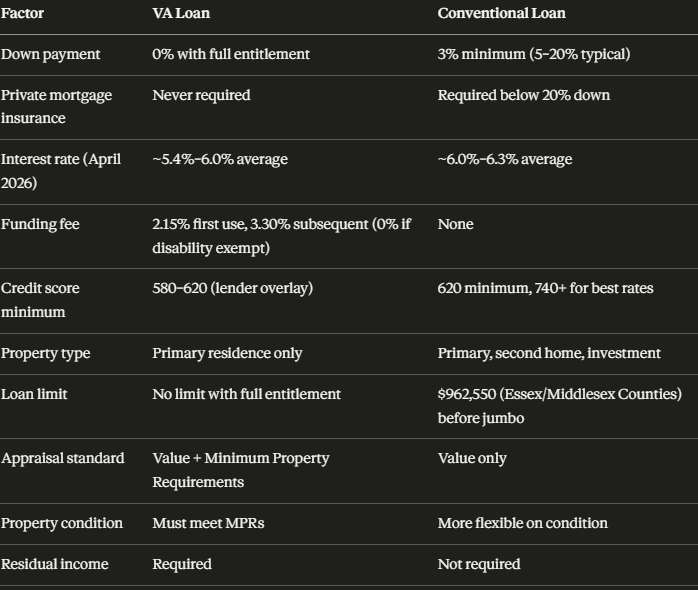
The Core Differences at a Glance
Before getting into the math, here is where VA and conventional loans differ in ways that matter to Massachusetts buyers in 2026.
The Monthly Payment Comparison — Massachusetts Numbers
Generic national comparisons do not serve Massachusetts buyers well. Home prices here are significantly above the national median. Running the numbers at Massachusetts price points changes the math meaningfully.
Here is a side-by-side comparison for a $700,000 purchase in Beverly, Salem, or Waltham in April 2026.
Scenario: $700,000 purchase, first-time VA loan user, 30-year fixed
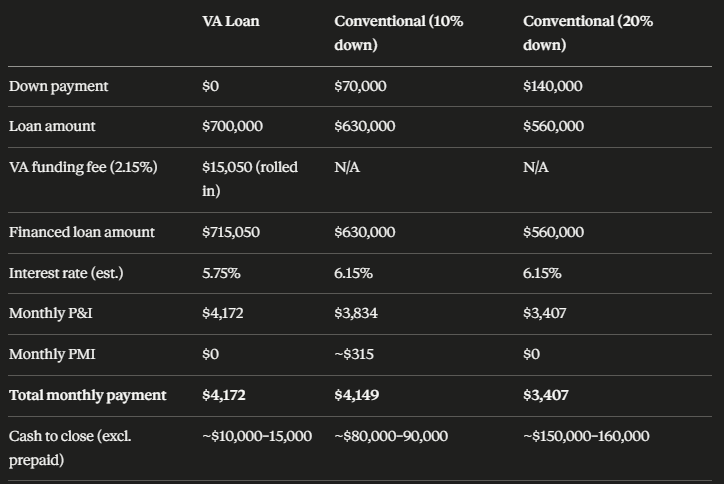
What the numbers show:
The VA loan and the conventional loan with 10% down produce nearly identical monthly payments in this scenario — but the VA buyer brings $70,000 less to closing. Over five years, the VA buyer retains that $70,000 in liquid savings or investments rather than having it locked in home equity.
The conventional loan with 20% down produces a lower monthly payment — but requires $140,000 more at closing than the VA loan. For most Massachusetts veterans who do not have $140,000 sitting in savings, that comparison is theoretical.
The disability exemption changes everything: Veterans with any VA-rated service-connected disability are completely exempt from the funding fee. For an exempt veteran on this $700,000 purchase, the VA loan amount stays at $700,000 rather than $715,050 — and the monthly payment drops to approximately $4,084. The VA loan wins on every metric.
The PMI Math — Why It Matters More in Massachusetts
Private mortgage insurance is the hidden cost that tips the VA vs. conventional comparison decisively in most Massachusetts scenarios. PMI is required on any conventional loan where the down payment is less than 20% — and in a market where median home prices exceed $650,000, 20% down means $130,000 or more out of pocket before closing costs.
PMI rates vary based on credit score, loan-to-value ratio, and lender. On a $630,000 conventional loan (representing 10% down on a $700,000 purchase) with a 700 credit score, PMI typically runs $0.40 to $0.55 per $100 of loan amount annually — which translates to $2,520 to $3,465 per year, or $210 to $289 per month.
On a VA loan, PMI is zero. Always. Regardless of down payment. For the life of the loan.
The cumulative impact over a typical Massachusetts ownership window of five to seven years:

PMI on a conventional loan is cancelable once you reach 20% equity — but in a $700,000 Massachusetts home, reaching 20% equity through payments alone takes over a decade at today's rates. Home appreciation can accelerate that timeline, but it is not guaranteed, and you cannot request PMI removal until the lender-mandated threshold is met.
Interest Rate Advantage — What the Current Spread Means in Massachusetts
As of late April 2026, VA loan rates are averaging 5.4% to 6.0% for well-qualified borrowers, while conventional 30-year fixed rates are running 6.0% to 6.3%. The typical spread is 0.25% to 0.50%.
At Massachusetts purchase prices, even the low end of that spread produces meaningful savings. Here is the impact of a 0.375% rate advantage on different loan amounts:
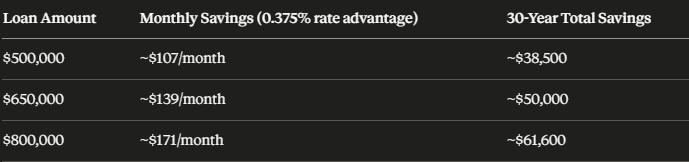
These are not projections — they are the math on a fixed rate advantage applied to a fixed loan amount over a 30-year term. Massachusetts veterans who purchase near the median price point and hold their loans for a meaningful period capture real, compounding savings from the VA rate advantage alone, before accounting for zero PMI.
The Funding Fee — When It Matters and When It Does Not
The VA funding fee is the one cost structure that can tilt the comparison toward conventional in specific scenarios. It is worth understanding precisely.
First-time use, no down payment: 2.15% of the loan amount. On a $700,000 purchase this is $15,050, rolled into the loan.
Subsequent use, no down payment: 3.30% of the loan amount. On a $700,000 purchase this is $23,100.
With 5% down: 1.50% regardless of prior use.
With 10% or more down: 1.25% regardless of prior use.
Disability exempt (any service-connected disability rating): 0%. The fee is waived entirely.
The funding fee matters most in the subsequent use, no down payment scenario — particularly for veterans who have used VA financing before, still own the prior home, and are purchasing again in Massachusetts while carrying the higher subsequent-use fee. In that scenario, the fee is $23,100 on a $700,000 loan. The monthly savings from no PMI and the lower rate still typically recover that cost within 3 to 5 years, but the breakeven calculation is worth running explicitly.
For disability-exempt veterans — and a significant percentage of Massachusetts veterans have some level of service-connected disability — the funding fee question is moot. The VA loan wins comprehensively on every metric.
VA Loans in Massachusetts's Competitive Market — Do They Compete?
One of the most common concerns among Massachusetts veterans is whether VA offers compete effectively in the North Shore and Greater Boston markets, where multiple offers, tight timelines, and seller selectivity are the norm.
The short answer is yes — when structured correctly by an experienced VA lender.
The longer answer involves understanding where the perception of VA loan weakness comes from and why it does not reflect the reality of a well-prepared VA offer.
The appraisal concern: VA appraisals assess both value and Minimum Property Requirements. The MPR concern is most relevant for properties with significant deferred maintenance — older Cape Cod homes needing roof work, properties with lead paint issues, homes with aging heating systems. For a well-maintained North Shore property in Beverly, Danvers, or Waltham, MPRs rarely create issues. The majority of VA appraisals in good-condition Massachusetts homes pass without conditions.
The timeline concern: VA loans managed by an experienced VA lender close in 30 to 45 days — identical to conventional. The timeline concern arises when a VA loan is handled by a lender who does not process VA transactions routinely and delays the appraisal order. Sean orders VA appraisals immediately upon ratified contract. This is the single most important timeline lever in a VA transaction.
The offer strength concern: A strong pre-approval letter from a Top 1% lender with a documented track record of VA closings carries real credibility with listing agents. Sean provides detailed pre-approval letters that include a direct contact number for listing agents to call and confirm financing status. Veterans who lose offers in competitive situations are overwhelmingly losing because of price, not because of VA financing.
The market reality: In the communities near Hanscom AFB — Bedford, Lexington, Burlington, Woburn — listing agents and sellers are familiar with VA loans. Military families have been buying in this corridor for decades. VA offers in these communities are received without the skepticism they might encounter in other markets.
When Conventional Beats VA in Massachusetts
There are clear scenarios where a conventional loan is the right choice even for a VA-eligible buyer. Being honest about these cases is part of making an informed decision.
When you are buying a second home or investment property: VA loans are restricted to primary residences. If you are purchasing a second home on the Cape, a rental property in Salem, or an investment property anywhere in Massachusetts, conventional financing is the only path. VA cannot be used regardless of how strong your eligibility is.
When the property has significant condition issues: A property needing major structural work, a failed septic system, significant roof damage, or other deferred maintenance that would trigger VA MPR conditions may be better purchased with conventional financing — particularly if the seller is unwilling to address conditions before closing. Renovation loans are another option in this scenario.
When you have 20% or more to put down and are funding-fee eligible (not exempt): If you have the full 20% down payment available and are a subsequent VA user paying the 3.30% funding fee, the math can shift. The $23,100 funding fee on a $700,000 purchase, combined with a conventional loan that avoids PMI entirely, means the conventional loan's monthly payment advantage may recover the fee savings within a reasonable timeframe. This scenario requires a specific side-by-side comparison.
When the property is a condo not on the VA-approved list: VA loans can only be used for condominiums that are on the VA's approved project list. If you identify a condo in Beverly or Salem that is not VA-approved, either conventional or FHA financing would be required. Sean verifies VA condo project status before you make an offer.
VA vs. Conventional for Hanscom AFB Buyers — A Specific Scenario
Active-duty service members receiving PCS orders to Hanscom Air Force Base in Bedford, Middlesex County, face a specific version of the VA vs. conventional decision worth addressing directly.
Most Hanscom-area buyers are purchasing in Middlesex County, where the 2026 VA loan limit for partial entitlement purposes is $962,550. For buyers with full entitlement, there is no limit. For buyers with a prior VA loan elsewhere, the partial entitlement calculation applies.
The Hanscom corridor communities — Bedford, Lexington, Burlington, Woburn — have median prices typically ranging from $650,000 to $900,000. At these price points, the VA loan's zero-down structure and no-PMI benefit are particularly impactful because conventional alternatives require either a very large down payment or a meaningful monthly PMI burden.
BAH rates for the Hanscom area are among the highest in the country, which increases qualifying income and supports purchase prices in this range. The VA loan's more flexible residual income calculation — which evaluates whether a borrower has enough left after all expenses, rather than applying a rigid DTI cap — often allows Hanscom buyers to qualify for more home than a conventional DTI-based analysis would suggest.
For most Hanscom PCS buyers, VA is the clear choice. The exception is the same as above: buyers with significant saved capital who want to purchase above the partial entitlement threshold without a down payment, or buyers whose prior VA loan is still active and whose entitlement calculation limits their zero-down ceiling in a high-cost market.
The Residual Income Requirement — A VA Advantage Most Buyers Miss
One underappreciated feature of VA underwriting that benefits Massachusetts buyers specifically is the residual income requirement.
Conventional loans qualify borrowers primarily through debt-to-income ratio — the percentage of gross monthly income consumed by debt payments. VA loans use DTI as well, but add a second qualification standard: residual income, defined as the amount of money a household has left over after all major monthly obligations are paid, including the new mortgage, taxes, insurance, and existing debts.
The VA sets residual income minimums by region and family size. For a family of four in the Northeast — which includes Massachusetts — the minimum residual income is $1,003 per month.
This matters in Massachusetts because the state's higher income levels mean many buyers in the North Shore and Greater Boston corridor have significant residual income even on large mortgages, which supports approval at price points that might be borderline under conventional DTI analysis alone. When a conventional lender says a buyer is at the edge of their DTI limit, VA underwriting may still produce a clean approval because the residual income calculation confirms the household can comfortably manage the payment.
Frequently Asked Questions — VA vs. Conventional in Massachusetts
Is a VA loan always better than a conventional loan in Massachusetts?
For most eligible veterans purchasing a primary residence with less than 20% down, yes. The combination of zero down payment, no PMI, and a lower interest rate produces a better financial outcome than conventional in most Massachusetts scenarios. The exceptions are investment properties and second homes (where VA cannot be used), properties with significant condition issues, and specific situations where a subsequent VA user with 20% down might prefer to avoid the 3.30% funding fee.
How much lower are VA loan rates compared to conventional in Massachusetts right now?
As of late April 2026, VA 30-year fixed rates are averaging 5.4% to 6.0% for well-qualified borrowers, while conventional 30-year fixed rates are running 6.0% to 6.3%. The typical spread is 0.25% to 0.50%. Actual rates depend on credit score, loan amount, lender, and market conditions on the day you lock.
Can I use a VA loan in a competitive bidding situation in Massachusetts?
Yes. A VA offer from an experienced VA lender competes effectively in Massachusetts's competitive market. The key variables are the strength of the pre-approval letter, the lender's VA track record, and the promptness of appraisal ordering. Sean provides credibility-building pre-approval documentation and direct availability for listing agents throughout the transaction.
Does the VA funding fee cancel out the benefits of no PMI and a lower rate?
For most Massachusetts buyers, no. On a $700,000 purchase, the 2.15% first-use funding fee is $15,050 — roughly equivalent to five years of PMI savings, after which the VA loan continues saving money indefinitely. Disability-exempt veterans pay no funding fee, making the comparison unambiguous. The subsequent-use 3.30% fee deserves a specific calculation at your purchase price.
Can a veteran use both VA and conventional financing simultaneously?
Yes, with separate properties. You can have an existing VA loan on one property and a conventional loan on another. This is common for veterans who own a VA-financed primary residence and purchase a second home or investment property with conventional financing.
What happens if the VA appraisal comes in low on a Massachusetts property?
If the VA appraisal comes in below the purchase price, you have three options: negotiate the price down to the appraised value, pay the difference between the appraised value and the purchase price out of pocket as an additional down payment, or walk away from the transaction using the VA escape clause. The VA Tidewater process also allows your lender to submit additional market data to the appraiser before the final value is issued. Sean manages this process proactively on every VA transaction.
Get a Side-by-Side Comparison for Your Specific Situation
The right choice between VA and conventional is not a general answer — it is a specific calculation based on your purchase price, down payment available, funding fee status, credit score, and whether you plan to use the property as a primary residence.
Sean Goudreau is a Top 1% Massachusetts mortgage lender and VA loan specialist based in Waltham. He has helped veterans on the North Shore and in Greater Boston navigate the VA vs. conventional decision since 2010, and runs a full side-by-side comparison — including real monthly payment numbers, total cash to close, and five-year cost comparison — as part of every free pre-approval consultation.
Request a Free Consultation or call Sean directly: (781) 202-9056 | NMLS# 326155